
An inch is a small unit of length, but it can be surprisingly difficult to picture if you do not have a ruler nearby. So, how long is 1 inch?
1 inch is exactly 2.54 centimeters or 25.4 millimeters. It is also equal to 1/12 of a foot.
That gives you the exact measurement, but numbers do not always make it easy to picture an inch in real life. If you want to know what 1 inch actually looks like, you can compare it with common objects such as a thumb, a small paperclip, or other familiar items.
In this guide, you will find the exact size of one inch, its conversions, everyday examples, ways to estimate it without a ruler, and how long one inch of hair looks.
Quick Reference: 1 Inch
| Measurement | Equivalent |
|---|---|
| 1 inch | 2.54 cm |
| 1 inch | 25.4 mm |
| 1 inch | 0.0833 ft |
| 1 inch | 0.0278 yd |
| 1 inch | 0.0254 m |
How Long Is 1 Inch Exactly?
One inch is a standard unit of length used in the imperial and United States customary measurement systems.
The exact length is:
1 inch = 2.54 centimeters
How big is 1 inch?
In simple terms, one inch is about the width or length of some small everyday objects, although most objects are not exactly one inch.
If you have a ruler, look at the space between the 0 and one-inch marks. That distance is exactly one inch.
Without a ruler, it is better to use familiar objects only as rough visual references because their sizes can vary.
1 Inch to CM
If you are converting inches to centimeters, the answer is straightforward:
1 inch = 2.54 cm
The conversion formula is:
Inches × 2.54 = centimeters
1 Inch to MM
One inch contains 25.4 millimeters.
So:
1 inch = 25.4 mm
The formula is:
Inches × 25.4 = millimeters
Here are a few common conversions:
| Inches | Centimeters | Millimeters |
|---|---|---|
| 1 inch | 2.54 cm | 25.4 mm |
| 2 inches | 5.08 cm | 50.8 mm |
| 3 inches | 7.62 cm | 76.2 mm |
| 4 inches | 10.16 cm | 101.6 mm |
| 5 inches | 12.7 cm | 127 mm |
This can be especially useful when switching between a ruler marked in inches and one marked in metric units.
What Does 1 Inch Look Like?
Knowing that one inch equals 2.54 cm is useful, but you may still be wondering what that length looks like.
Imagine a ruler with the zero mark at one end. The distance from zero to the one-inch mark is one inch.
If you do not have a ruler, you can use familiar objects as visual references. Just remember that these examples are approximate, not guaranteed to measure exactly one inch.
Your own thumb is sometimes used as a quick reference for an inch, but thumb sizes vary considerably from person to person. The same is true for objects such as bottle caps, buttons, paperclips, and other small items.
For an accurate measurement, always use a ruler, measuring tape, or another properly marked measuring tool.
Everyday Things That Can Help You Picture 1 Inch
A few familiar objects can make it easier to understand the approximate size of an inch.
1. The width of a thumb
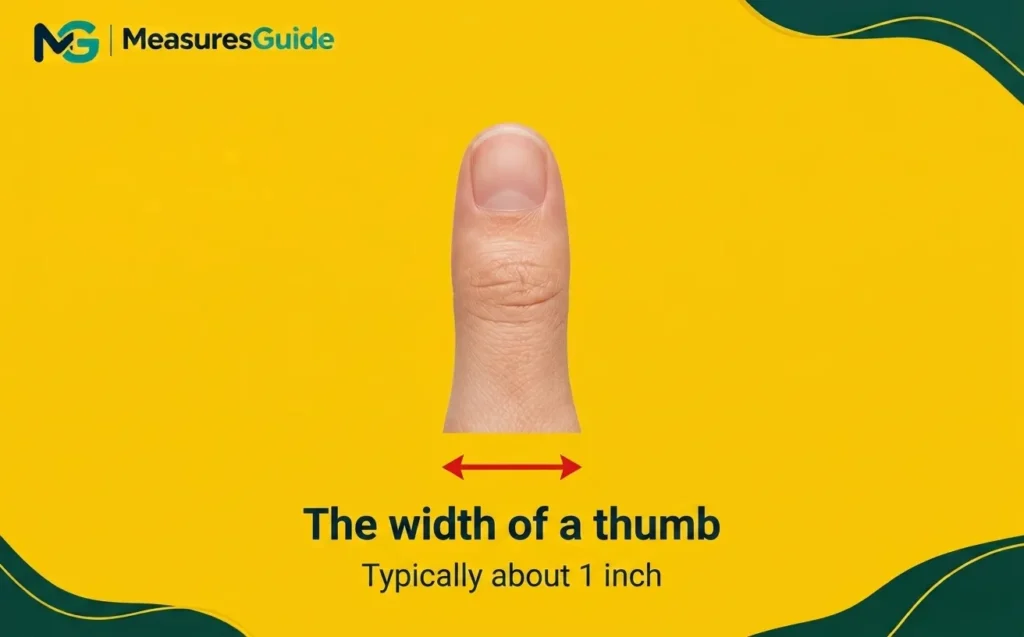
The width of part of your thumb can sometimes be close to an inch, which makes it a convenient quick estimate.
However, this is not an exact method. Children’s thumbs, adult thumbs, and individual hand sizes can be very different.
2. A small paperclip
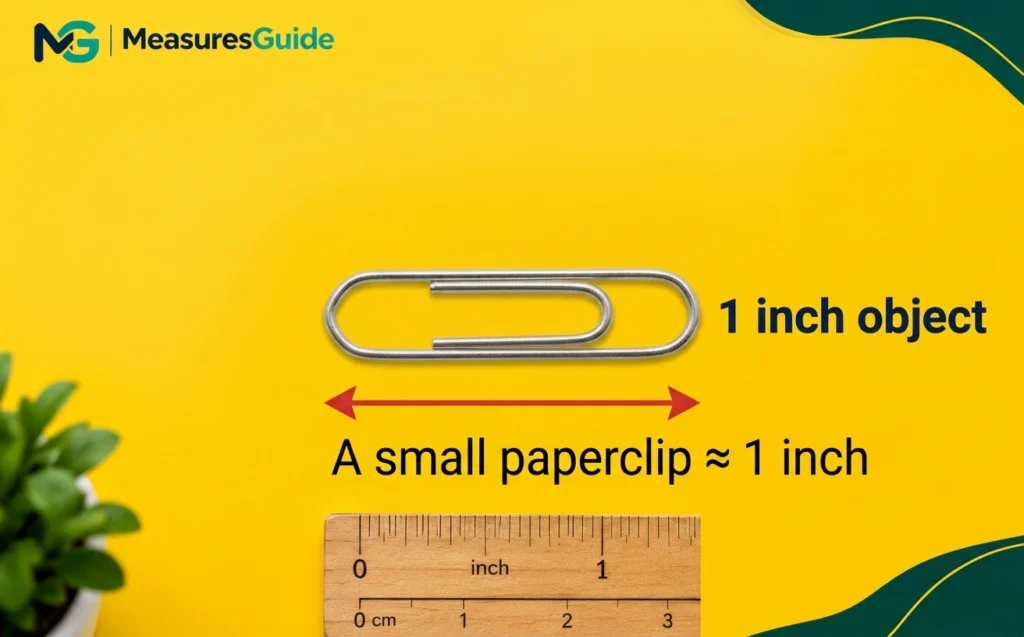
A small paperclip can give you a rough visual idea of an inch. Paperclips come in different sizes, so check the actual length if accuracy matters.
3. A button
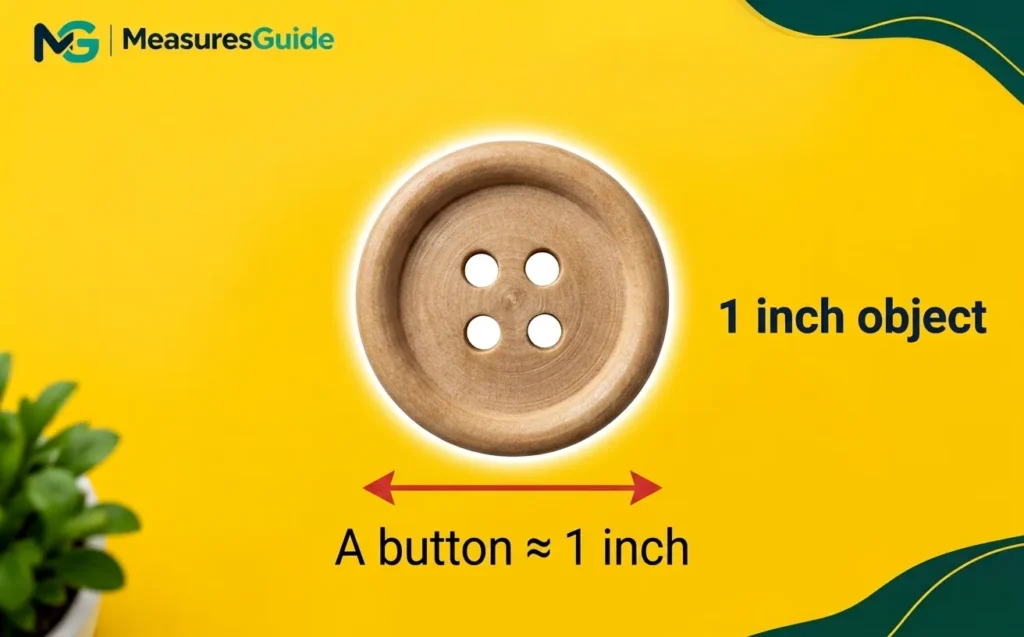
Some small buttons are around an inch across. Clothing buttons vary widely, though, so a button should only be treated as a visual comparison.
4. A small bottle cap
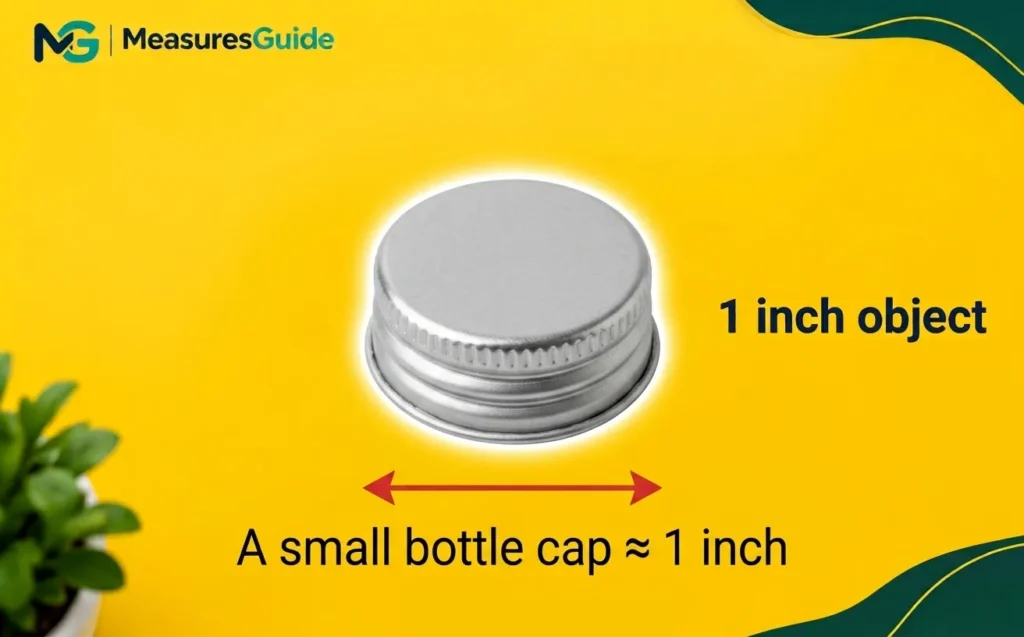
Some bottle caps can be close to an inch in one dimension, but cap sizes differ between products and brands.
5. A small object on a ruler
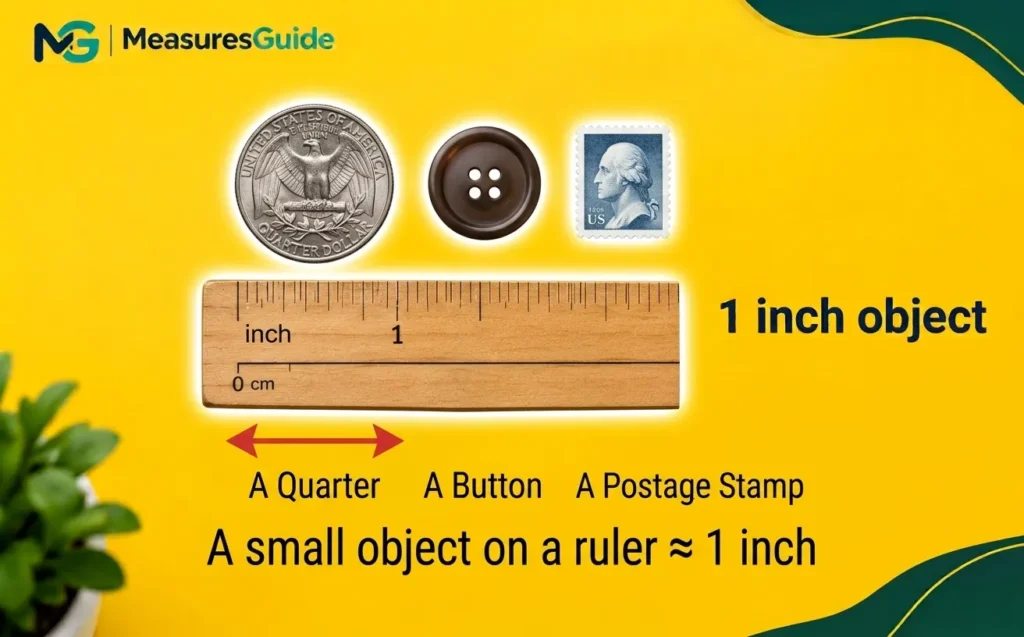
If you have a ruler, you can compare an object directly with the 1-inch mark. This is much more reliable than guessing from memory.
The important point is that everyday objects are useful for visualization, not precision.
How to Measure 1 Inch Without a Ruler
Sometimes you need to estimate an inch when you do not have a ruler nearby.
Here are a few simple methods.
Use your thumb as a rough guide
Look at the width of the first part of your thumb and compare it with the length you are trying to estimate.
This can be useful for a quick guess, but it should not be used when an accurate measurement is important.
Use a familiar object
If you know that an object is close to one inch, you can place it next to the item you want to estimate.
Again, remember that the object may not actually be exactly one inch.
Use a credit card or another standard object carefully
Some people use familiar items as reference points for estimating small measurements. This can help with visual comparison, but objects should not be assumed to have a particular measurement unless you know their actual dimensions.
Use your phone only with caution
A phone screen can display a ruler or measurement tool, but the result depends on screen size, display scaling, and calibration. A digital ruler that has not been calibrated should not be treated as an accurate physical ruler.
If accuracy matters, use a real ruler or measuring tape.
1 Inch Compared With Other Measurements
It can be easier to understand an inch when you compare it with other lengths.
1 inch vs. 2 inches
Two inches is exactly twice as long as one inch.
- 1 inch = 2.54 cm
- 2 inches = 5.08 cm
1 inch vs. 3 inches
Three inches is three times the length of one inch.
- 1 inch = 2.54 cm
- 3 inches = 7.62 cm
1 inch vs. 1 centimeter
An inch is longer than a centimeter.
- 1 inch = 2.54 cm
- 1 cm = about 0.394 inch
So, one inch is a little more than two and a half centimeters.
Is 1 Inch the Same Everywhere?
Yes. The modern inch is defined as exactly 2.54 centimeters.
What can change is the way people estimate an inch using everyday objects.
For example, one person’s thumb may be close to an inch wide while another person’s thumb may be noticeably wider or narrower. A bottle cap from one product may also be a different size from a bottle cap from another product.
That is why visual examples are useful for understanding scale, but they should not replace an actual measuring tool when precision is required.
Where Is 1 Inch Commonly Used?
Inches are used in many everyday measurements, particularly in the United States and in industries or products that use imperial measurements.
You may come across inches when measuring:
- Clothing and fabric
- Furniture
- Wood and construction materials
- Tools
- Electronics
- Screen sizes
- Picture frames
- Packages
- Small household objects
- Hair length
For example, a measurement might be written as 1 inch, 1.5 inches, or 2 inches depending on what is being measured.
Visit Also: Measures Guide
FAQs
How long is 1 inch in centimeters?
one inch is exactly 2.54 centimeters.
How many millimeters are in 1 inch?
There are exactly 25.4 millimeters in one inch.
How big is 1 inch?
One inch is 2.54 cm long. For a quick visual idea, it is roughly the size of some small everyday objects, although those objects can vary in size.
What does one inch look like?
On a ruler, one inch is the distance between the 0 and one-inch marks. Without a ruler, you can use objects such as your thumb or a small item as a rough visual reference.
Can I measure one inch without a ruler?
Yes, you can estimate an inch using your thumb or a familiar object, but these methods are not guaranteed to be accurate. Use a ruler or measuring tape when precision matters.
How long is one inch of hair?
One inch of hair measures 2.54 cm or 25.4 mm. Its visible length can vary depending on whether the hair is straight, wavy, or curly.
Is 1 inch longer than one centimeter?
Yes. One inch equals 2.54 centimeters, so an inch is more than twice as long as a centimeter.
Is 1 inch exactly 2.5 cm?
Not exactly. One inch is 2.54 cm. Saying 2.5 cm is only a rounded approximation.
Conclusion
So, how long is 1 inch?
1 inch is exactly 2.54 centimeters or 25.4 millimeters.
If you are trying to picture it without a ruler, think of it as a small length that is roughly comparable to some familiar everyday objects, but keep in mind that those objects are only estimates.
For accurate measurements, the simplest option is still a ruler or measuring tape. And if you are talking about hair, 1 inch of hair is also exactly 2.54 cm or 25.4 mm, although curly or wavy hair may look shorter because of its natural shape.